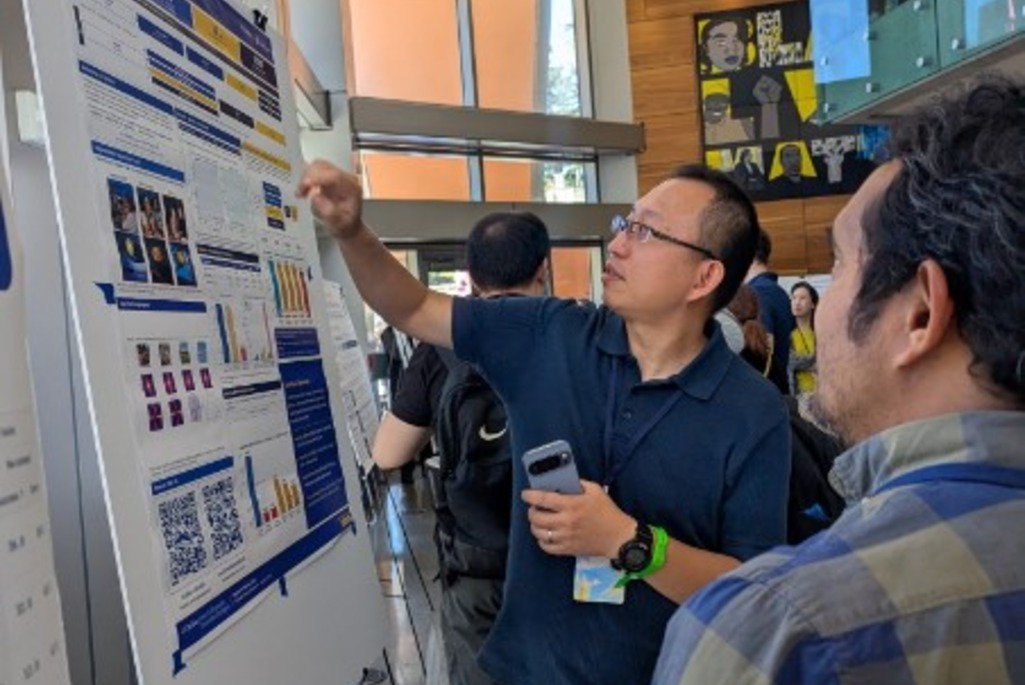
This summer, ScienceIT contributed to four research posters presented at three conferences, highlighting work in AI for science, trustworthy AI, and AI security. The projects involved collaborations across Berkeley Lab and with external research partners, exploring practical ways to identify synthetic content, safeguard scientific data, and protect the provenance of AI models.
At ISMB 2026, a leading international conference in computational biology and bioinformatics, ScienceIT collaborated with researchers from JGI on “GenomeOcean-Sentinel.” The project investigates whether genome foundation models leave detectable signatures in synthetic DNA. Identifying these signals could help researchers distinguish generated sequences from naturally occurring genomic data—an increasingly important capability for maintaining data integrity and strengthening biosecurity as generative AI becomes more widely used in biological research. You can watch the presentation here.
At SIGGRAPH 2026, ScienceIT’s Fengchen Liu collaborated with researchers at UC Berkeley and other academic institutions on “Radial Residual Frequency: A Semantically Aligned Benchmark and Spectral Detector for AI-Generated Images.” The work examines subtle patterns in the frequency domain that may reveal whether an image was produced by AI. By focusing on signals that persist across modern image-generation systems, the research aims to make the detection of synthetic and deepfake imagery more accurate and reliable.
Two additional projects were featured at the Berkeley RDI Agentic AI Summit 2026. “Beyond Pixels in the Robust Detection of Photorealistic AI Imagery” was developed through collaboration between ScienceIT and researchers at UC Berkeley and other academic institutions, exploring methods for detecting highly realistic AI-generated images and deepfakes under varied real-world conditions. “Asking Back: Interaction-Layer Antidistillation Watermarks” brought together ScienceIT, Berkeley Lab research expertise, and external research collaborators to address AI model provenance and intellectual property protection. Rather than embedding a conventional watermark in model outputs, the approach uses behavioral markers designed to survive model distillation and remain discoverable through black-box auditing.
Across the four projects, ScienceIT contributed research and technical expertise to collaborations spanning genomics, synthetic-media detection, and AI model security.
“Working with researchers across Berkeley Lab’s divisions gives ScienceIT an opportunity to help make complex AI research accessible without losing its scientific depth,” said Fengchen Liu, ScienceIT consultant. “The work spans genomic data integrity, synthetic-image detection, and model provenance, showing how computing and AI expertise can support very different areas of scientific research.”
Together, the four presentations reflect the breadth of AI research supported by ScienceIT from genomics and scientific data integrity to image authenticity and model security. They also illustrate the value of pairing deep technical expertise with strong scientific communication, helping Berkeley Lab researchers share emerging ideas, invite collaboration, and advance the responsible use of artificial intelligence.

