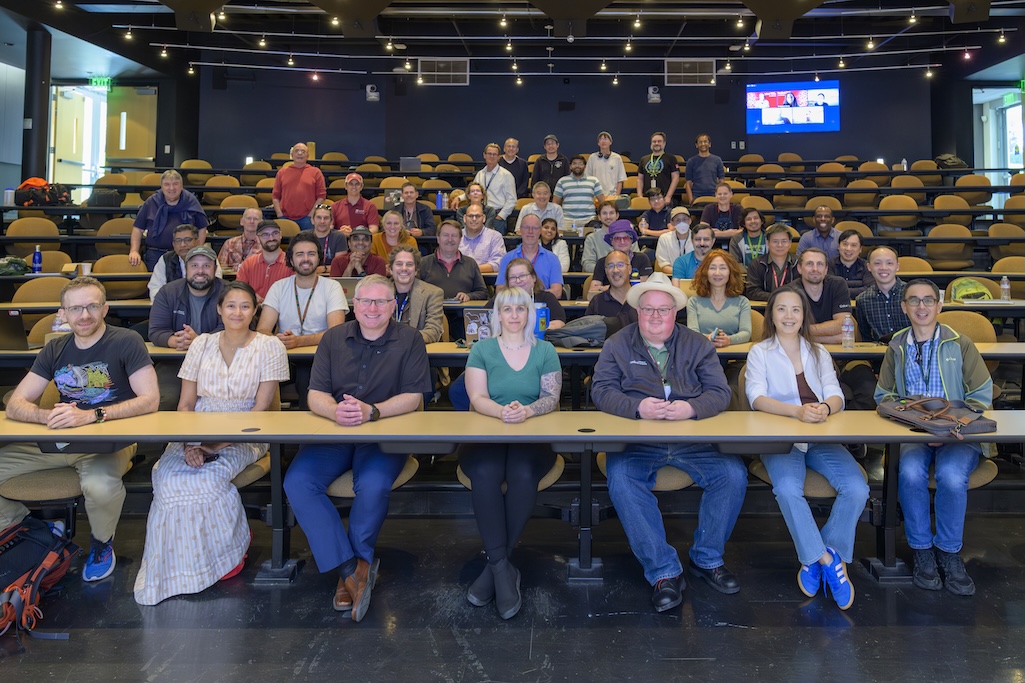
Last month Berkeley Lab IT Division’s ScienceIT team attended the Technology Exchange, which is an important forum for collaboration among the Bay Area’s leading research computing institutions. This invite-only annual event brought together IT professionals and administrators from Stanford University, UC Berkeley, SLAC National Accelerator Laboratory, UC Merced, and Berkeley Lab to share insights, discuss challenges, and explore the evolving landscape of high-performance computing (HPC). Designed to foster knowledge exchange and deepen connections, the one-day gathering reinforced a strong regional community and sparked opportunities for future collaboration. This year’s event took place at SLAC.
A Snapshot of Scale and Impact of HPC
The event opened with site reports from each institution, offering a clear view into the scale and diversity of their operations. The numbers highlight just how critical HPC has become: Stanford supports approximately 8,500 users, SLAC serves 3,800 users across 27 divisions, UC Berkeley supports over 3,000 users, and Berkeley Lab supports 1,800 users spanning six research centers and 22 divisions. Across all sites, HPC centers are doing essential heavy lifting, powering research that spans disciplines and drives scientific discovery.
Growing Demands and Shared Challenges
Alongside this impact, institutions are facing a common and increasingly complex set of challenges. Rising hardware costs and the rapid growth of AI-driven workloads are making it harder to sustain and expand infrastructure. Supply chain delays continue to slow procurement. The lifecycle of GPUs is shrinking as new generations are released at an accelerating pace, necessitating a more strategic approach to hardware acquisition. Power consumption is also a growing concern. Stanford, for example, is planning for an expanded data center with capacity up to 15 megawatts, while UC Berkeley is navigating space constraints by leasing additional data center capacity at NASA’s Ames Research Center.
Aging Infrastructure and Urgent Needs
Berkeley Lab shares many of these challenges, with the added pressure of aging infrastructure. A significant portion of its data center hardware is operating beyond its intended lifespan, underscoring a pressing need to invest in current CPUs, GPUs, and essential infrastructure.
“Addressing this gap is vital to ensuring the laboratory remains at the forefront of dependable, competitive research computing,” noted Wei Feinstein, head of the ScienceIT department. “As the pace of scientific discovery accelerates, due in large part to AI and data-intensive research, our infrastructure must evolve just as quickly. A strategic investment in modern systems is essential not only to meet current demand, but to enable the next generation of innovation across the Lab.”
Storage, AI, and What’s Next
Across all institutions, storage demand continues to rise sharply, driven by increasing data volumes and the growing role of AI in research and productivity. Keeping storage capacity aligned with cost and demand remains an ongoing struggle.
The afternoon breakout sessions provided an opportunity to explore these issues in more depth, with tracks focused on data center infrastructure, storage, data security and responsibility, software installation and management, user engagement and training, and AI. Together, these discussions highlighted both the complexity of today’s HPC environment and the importance of continued collaboration to meet future demands.
The HPC Technology Exchange underscored both the critical role of high-performance computing in advancing research and the shared challenges institutions face in sustaining it. As demand for compute power, storage, and AI capabilities continues to grow, so too does the need for modern infrastructure, strategic investment, and collaborative problem-solving. By bringing together regional partners to exchange insights and align on emerging needs, the event reinforced the importance of a connected HPC community—one that is better positioned to innovate, adapt, and support the future of scientific discovery.

